Objectives. Our Mathematical Modelling Unit was officially launched in February 2023. The objectives of this Unit in the fight against infectious diseases include understanding disease dynamics, predicting outcomes, evaluating interventions, optimizing resource allocation, informing policy-decisions, and fostering collaboration. By developing mathematical models, the unit aims to provide insights into disease transmission, anticipate future trends, assess the effectiveness of interventions , guide resource allocation, support evidence-based policymaking, and collaborate with stakeholders to enhance disease prevention and control efforts.
Goals. The goals of our Mathematical Modeling Unit are centered around the study of vectors population dynamics, specifically in host-natural enemy interactions, to gain a deeper understanding of the fundamental processes underlying the epidemiology, ecology, and evolution of infectious diseases. Our research combines mathematical analysis and modeling techniques, with a specific focus on dynamic systems. Through our work, we aim to provide valuable information that can inform decision-making strategies for the prevention and management of infectious diseases. Our current activities involve developing and refining mathematical models, analyzing data, conducting simulations, and collaborating with experts from various fields to enhance our understanding of infectious diseases and contribute to effective control and prevention measures.
- CURRENT PROJECTS
VIMC climate change
The Vaccine Impact Modelling Consortium (VIMC) has secured funding of £12.8 million (USD $15.4 million) for the next five years for its new phase, VIMC 2.0. This phase will focus on modeling to address vaccine policy and practice questions and will involve a more diverse international community of modelers. Additionally, VIMC will establish a research program to study the impact of climate change on climate-sensitive vaccine-preventable diseases. For more informations click on this link (https://www.vaccineimpact.org/2022-11-14-VIMC-2-0-funding/)
ACoMVeC
The African Consortium in Modeling for Effective Vector Control (ACoMVeC) is a collaborative initiative led by Charles Wondji Centre for Research Infectious Diseases Cameroon. The project aims to strengthen malaria control efforts by bringing together African scientists and partners from the United States and the United Kingdom. The consortium has established partnerships with seven research institutes across Africa and provide training to 15 PhD-Students in Mathematical Modelling from French- and English-speaking African universities.
Read more …(https://gcgh.grandchallenges.org/grant/malaria-modeling-field-strengthening-acomvec)
ANR QUASAR
Given the pathogen’s evolving nature, long-term antimicrobial effectiveness is a significant public health concern. To address this issue, we need strategies that account for the continuous character of antimicrobial resistance, including intermediate resistance (tolerance), and to understand how virulence and resistance are related in colonizing parasites. Currently, there is a lack of recommendations based on robust mathematical models to combat antimicrobial resistance.
(https://anr.fr/Projet-ANR-21-CE45-0004)
- CURRENT ACTIVITIES
Antimicrobial resistance (AMR) and Insecticide resistance (IR):
Herer, our primary focus is on enhancing empirical treatment strategies and investigating the relationship between AMR and antimicrobial usage. We also study the co-evolution of virulence and resistance. Our approach utilizes an integro-differential system with non-local terms, which is well-suited for studying the evolutionary dynamics of biological processes, including epidemiological and within-host dynamics, without relying on the time scale separation hypothesis.
We are actively researching and studying insecticide resistance. While specific details are not provided, our work involves examining the dynamics and mechanisms of insecticide resistance in relevant populations.
Climate change and infectious diseases:
We employ forecasting-based approaches to comprehend the impact of environmental and climatic variables on the epidemiology of infectious diseases, including vector-borne diseases and respiratory infections.
Human malaria:
Our research involves developing models to describe the within-host dynamics of various Plasmodium species such as P. falciparum, P. vivax, or P. malariae. For the parasitized stage of red blood cells (RBCs), we consider age-structured dynamics where age is a continuous variable representing the time since the RBC became parasitized. Additionally, our models easily accommodate the inclusion of anti-malarial treatments targeting specific stages of parasite development within the parasitized RBCs. At the epidemiological level, we are also working on malaria transmission models incorporating seasonal mosquito life-history traits.
Covid-19:
Our focus is on developing models to alleviate the burden of COVID-19 in hospital intensive care units and optimize control strategies, including both pharmaceutical and non-pharmaceutical interventions.
UNIT LEAD
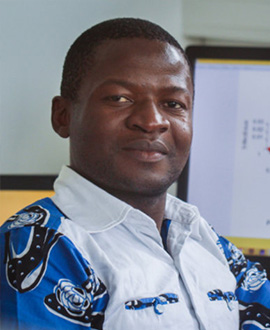
Prof Ramsès Djidjou-Demasse
Modeler, Institut de Recherche pour le Développement (IRD)
PRINCIPAL INVESTIGATORS
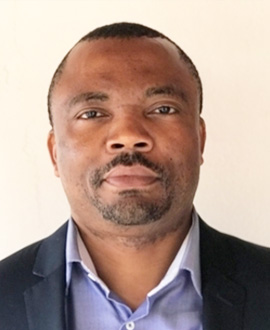
Prof Charles Wondji
Wellcome Trust Senior Research Fellow & Executive Director at CRID Vector Biology Department
Prof Ramsès Djidjou-Demasse
Modeler, Institut de Recherche pour le Développement (IRD)
POST DOC

Dr Luther Mann
Dr. Luther Mann is a postdoc at CRID under the Vaccine Impact Modelling Consortium (VIMC). He is working on mathematical modelling to address…
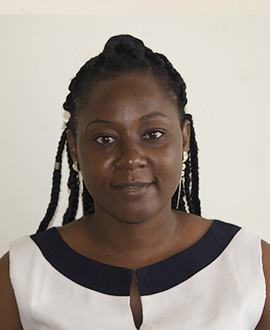
Dr Michele Yimga
Michele is a postdoc at CRID under the African Consortium in Modelling for Effective Vector Control (ACoMVeC). Michele has a Msc and a Ph.D…..
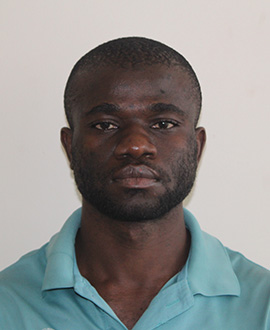
Dr William Kuipou

Dr Hyacinthe Ndongmo
Post doctoral Fellow, MIVEGEC, University of Montpellier, IRD, CNRS, Montpellier, France. PhD Degree, Applied Mathematics – University of Dschang Cameroon….
PhD STUDENTS

Manuela Nimpa

Sylvère kezeta
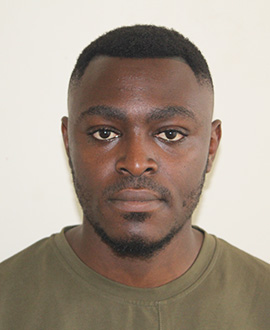
Franck Dongmo

Pascal Sungu Ngoy

Chadrac Ntembue

Malick Pane
TEAM MANAGEMENT

IVAN MISONGE
Project Manager

Essame Bruno
Administrative support
PARTNERS AFRICA AND NORTH